Variable demand
The number of employees on site changes by day, so yesterday’s parking plan may not fit today.
PARKING THAT FOLLOWS ATTENDANCE
Hybrid work makes fixed parking assignments inefficient. ParkON lets employees reserve parking only for the days they come to the office.
Flexible parking for a flexible week
WHEN ATTENDANCE CHANGES DAILY
Hybrid teams do not arrive in the same numbers every day. A quiet Monday can be followed by a crowded Tuesday, while permanently assigned spaces remain empty when their owners work remotely. First-come-first-served parking creates a different problem: nobody knows whether the commute will end with a space.
The number of employees on site changes by day, so yesterday’s parking plan may not fit today.
Permanent allocations can waste capacity whenever their assigned employees work elsewhere.
Without advance reservations, employees and workplace teams see pressure only when people arrive.
ONE PLACE. ONE CURRENT VIEW.
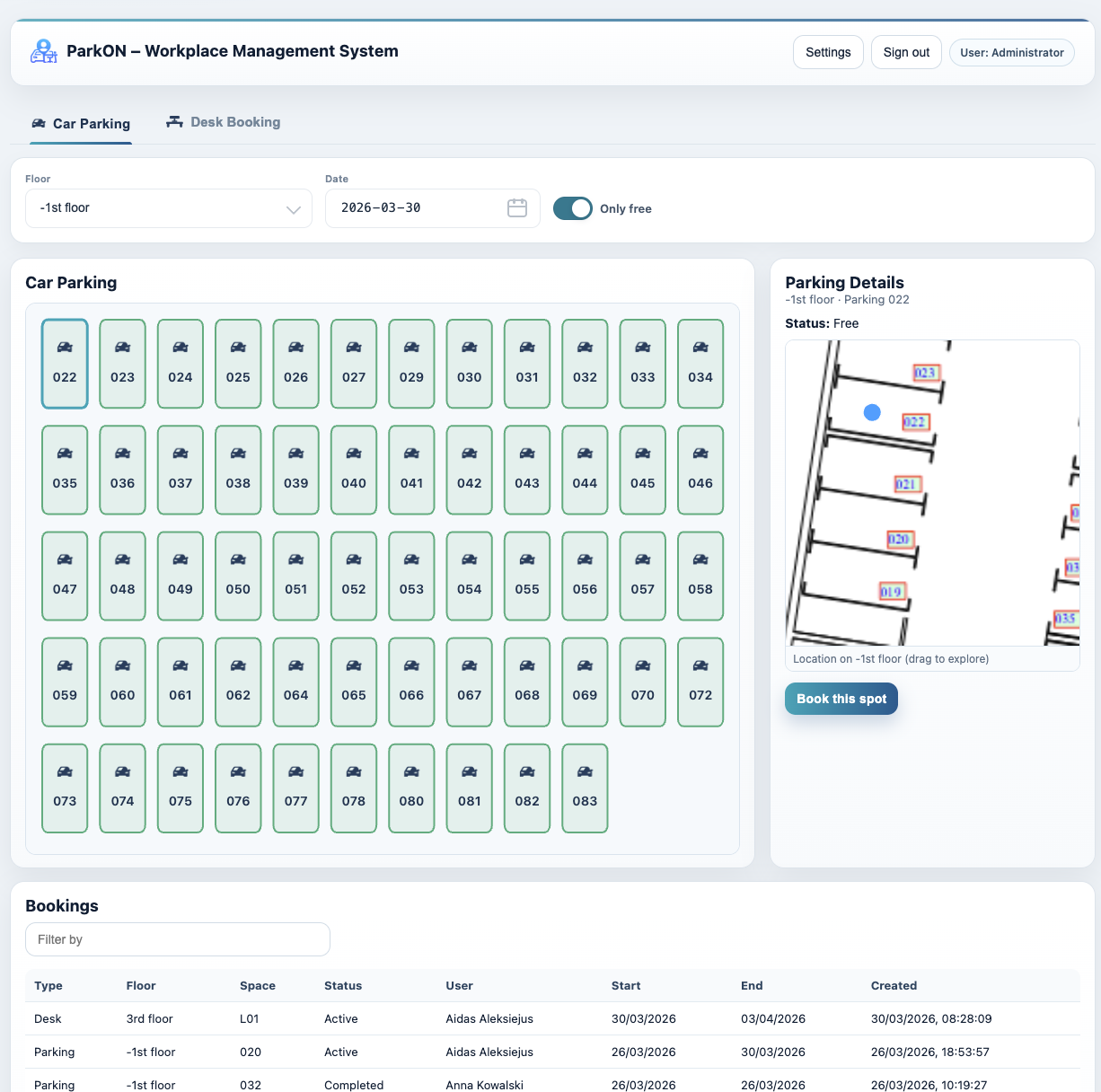
ParkON creates a shared pool of workplace parking that employees can reserve for the dates they plan to come in. Availability changes with confirmed bookings and released spaces. Administrators keep control of parking floors, individual bays, user access and how far in advance reservations can be made.
HOW PARKON WORKS
Three clear steps. No side spreadsheets or message threads.
An employee decides when they will work on site and checks that date in ParkON.
They see the available workplace spaces and reserve a specific bay before the commute.
Confirmed and released reservations update the shared view, giving everyone a clearer picture.
BUILT AROUND THE WORKDAY
Hybrid workplace parking works best when access follows actual attendance. Shared reservations give employees predictability without requiring a permanent space for every person.
Spaces can be used by different employees on different days instead of sitting empty.
People book parking around the days they choose or are expected to work from the office.
Employees can see availability before travelling, even when popular office days are busy.
One current booking view replaces the work of manually reallocating parking each week.
A PRACTICAL EXAMPLE
A company has 100 employees, but only 50–60 work from the office on a typical day. There are 30 parking spaces. Permanent assignments waste capacity, while first-come-first-served creates uncertainty. ParkON turns those 30 spaces into a shared pool: employees reserve a bay for their planned office days, then release it if their plans change.
Demand becomes less consistent. Different people attend on different days, which makes permanent allocations less efficient and unplanned first-come-first-served parking less predictable.
Permanent spaces can still make sense for specific accessibility or operational needs. Where attendance varies, a shared booking pool often makes the remaining capacity available to more employees.
Yes. Employees select the date they plan to attend and reserve parking for that day, rather than holding a permanent space throughout the week.
Yes. ParkON makes limited parking visible and bookable, helping different employees use the same spaces on different days. It does not create capacity, but it makes the available capacity clearer and easier to share.
PARKING, PLANNED
See how ParkON fits your workplace parking.